The Big Decline Is on the Horizon: My First MS MRI and the Gadolinium Nightmare

I’ll skip the layup to this next appointment. It’s been a few weeks since my initial neurologist consultation. They’re leaning heavily toward Multiple Sclerosis (MS). Looking back, the mounting stress from those first three medical appointments undoubtedly poured gasoline on the fire, accelerating the speed of my physical progression.
What you are about to read is a dark chapter in my health journey, a day that permanently altered my perspective on chronic illness, medical procedures, and how much the human body can take before it violently rebels.
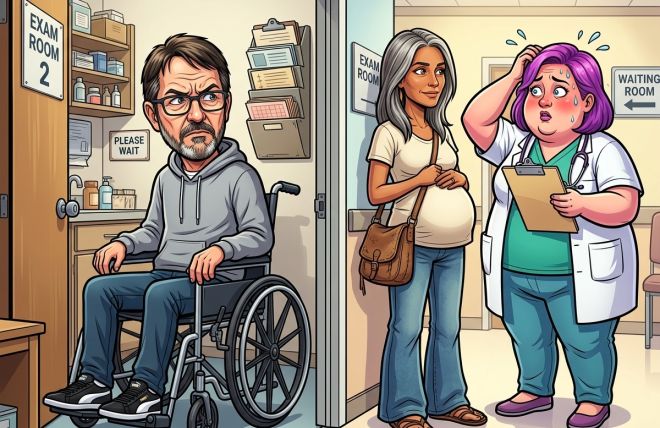
It was the big day. I didn't know what to expect, and I was unquestionably nervous, filled with a suffocating sense of anxiety. I was heading to this crucial appointment on a solo mission. At that point, I was still driving myself to work, doing what I could to maintain a semblance of normalcy. I had good days and bad days. But this particular day took the anxiety completely off the charts.
The Setup: Entering the Modern Medical Complex
The day started like no other. I headed to the appointment at a sprawling local health complex. Today was the day for my brain and spine MRI.
For the uninitiated, an MRI (magnetic resonance imaging) is considered a "safe," non-invasive medical test that uses a powerful magnetic field and radio waves to generate remarkably clear, detailed pictures of the inside of your body. To doctors, it’s just another Tuesday. To a patient waiting for a life-altering diagnosis, it’s a portal into the unknown.
I made my way into a modern, clean waiting room. The nurses could not have been nicer. By this stage in my health journey, I had mastered the art of masking my terror, hiding my stress and anxiety with a practiced ease. It certainly didn’t hurt that these were some of the prettiest nurses I’d encountered thus far.
To give you an idea of how unconcerned or perhaps overwhelmed we both were, my wife had decided to let me go solo. Big mistake.
A nurse led me down a sterile hallway to a small exam room. She instructed me to strip down to my underwear and put on a paper-thin hospital smock folded neatly on the edge of the examination table. That was the last moment of calm I would experience all day.
The Turning Point: The Injection
Next, the nurse walked back into the room holding a needle.
This is where my journey took a genuinely horrible turn. I don't like needles. But more than that, I have a visceral, deep-seated hatred for people sticking sharp objects into my skin. Unsurprisingly, my anxiety levels spiked.
"What is this you are injecting into me?" I asked, my voice tighter than intended.
She offered a standard, rehearsed medical explanation: An MRI injection, commonly referred to as an "MRI with contrast", is the intravenous delivery of a special liquid dye, usually containing a heavy metal called gadolinium, administered right before or during a magnetic resonance imaging scan to highlight lesions or inflammation.
"You might feel a brief cool or warm sensation running up your arm, or notice a temporary metallic taste in your mouth," she added reassuringly.
To put it mildly, she understated it.
I felt the liquid going in immediately. It started as an intense warmth spreading through my entire arm. The nurse calmly instructed, "Now, just wait for about 20 minutes for the dye to circulate while you pick out some music for your headphones in the MRI machine."
Then, suddenly, it must have hit my heart.
My entire body started overheating. I was sweating profusely from every single pore. When I say sweating, I don't mean a polite glow, I mean I was dripping wet, as if I’d just sprinted a marathon in heavy winter gear.
Panicked, I flagged the nurse down when she walked past and asked if this extreme reaction was normal. She muttered something vague about the ambient temperature in the room and completely blew me off.
Into the Chamber of Horrors
Next, they started leading me down the hall toward the cavernous room housing the MRI machine. The moment I stood up from the chair, a wave of violent nausea hit me. I was dizzy to the point of almost throwing up right there on the linoleum.
Recognizing I was losing control, I made a desperate pit stop at the restroom. I looked in the mirror while splashing cold water frantically on my face. I looked a pale shade of green, though whether it was the harsh fluorescent lighting or the fact that I was actively turning green, I couldn't tell you.
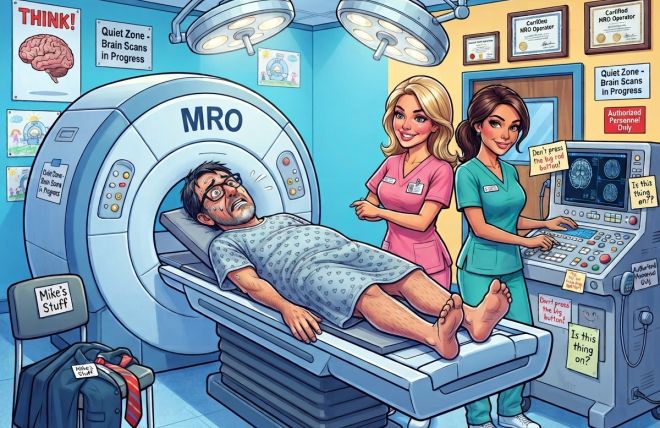
They led me into the MRI suite and told me to lie flat on the sliding table. Technicians placed a rigid, cage-like apparatus over my head, locking it in place.
"Hold completely still," they instructed. "And when the buzzer rings, hold your breath."
I nearly suffered a full-blown panic attack right then and there. I am already dealing with baseline claustrophobia. Gazing up at the low ceiling of the room, I almost made them pull me out of the machine before it even started. I genuinely thought I was going to have a heart attack when the table slowly fed me into the tight, enclosed tunnel.
Still feeling like I was about to vomit everywhere, the taste in my mouth morphed into something truly vile, it tasted like I was chewing on rusty metal. It was all so surreal, so crazy, and they hadn't even taken a single scan yet.
You all reading this might not have had the same catastrophic physical reaction I did. To put my medical history in perspective: I had never had anything injected into my body intravenously, save for a local anesthetic when I had my wisdom teeth removed decades prior, and that had been a miserable experience, too. I was never vaccinated with an injection, nor had I ever spent time as a hospital patient. My body was entirely unprepared for this chemical assault.
The Scan and the Aftermath
Then, it was time. Everyone left the room, sealing the heavy door. They communicated with me remotely through an overhead speaker system. My anxiety was redlining, and the machine finally fired up.
They slid me deeper into the magnetic tube. It was kind of a blur while the machine was actively scanning. Deafening thumping, banging, and clicking noises echoed inside the cylinder. Music was playing faintly through my headphones, but it was drowned out by the mechanical symphony. Between the claustrophobia, holding my breath on cue, and fighting a desperate urge to puke inside the head cage, it felt like an eternity.
Finally, mercifully, the machine turned off. The room lights clicked on, and it was over.
I felt like I had just been on a severe, non-consensual LSD trip for a week. I was dizzy, utterly exhausted, and felt a profound physical sickness that I needed to expel whatever toxic substance had just been injected into my veins.
The technicians led me back to the changing area, and it was clear from my appearance that I was in acute distress.
"Get changed and take your time," one of them said gently. "Stay as long as you need."
I changed back into my street clothes as fast as humanly possible and fled that building like I had just robbed the place.
The Two-Day Crash
I stumbled out to my car, but the moment I sat in the driver's seat, I realized with absolute certainty that I could not drive. I was spinning. I reclined my seat and took a forced nap right there in the medical complex parking lot.
After about an hour of restless, sweaty sleep, I somehow pulled myself together enough to navigate the drive home.
The moment I walked through my front door, I collapsed into bed and slept for two straight days. I couldn’t even hold my eyes open. It felt like enduring a chemically induced, multi-day bender. My head was spinning with relentless vertigo, deep nausea kept me from eating a single bite of food, and I could barely manage small sips of water.
It was an extreme, systemic crash that lasted for 48 brutal hours before my body relented just enough so I couldn't bear to lie in bed another second. Once I finally started forcing myself to move around the house and crawl back toward a semblance of a "new normal," the crushing nausea slowly began to decline.
All told, it took at least seven full days for my body to stop feeling the lingering, toxic impact of that single contrast injection.
I walked into that hospital looking for answers about my neurological symptoms, hoping for clarity. Instead, I left with a traumatized nervous system and a whole new category of physical suffering.
In the next installment of this journey, I’ll explain what I later uncovered about that day, and the startling truths I learned when I finally started researching the medical realities behind my impending diagnosis.
Stay tuned for the next chapter. The descent is only just beginning.