Stepping Into the DeLorean: What That MRI Contrast Injection Taught Me Too Late

Let’s fire up the DeLorean, punch in a destination, and take a quick trip forward in time. Not to hover cars or flying skateboards, mind you, but to the exact moment I finally figured out what was actually inside that MRI contrast injection, and why my body completely rebelled against it.
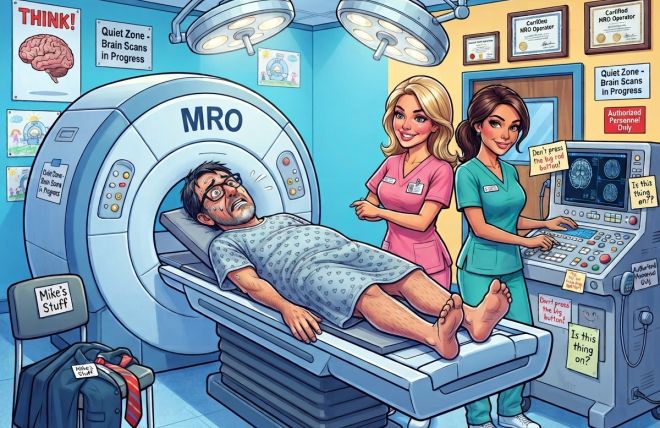
Picture this: I was sick in every way imaginable. It genuinely felt like I had been hit by a freight train, dragged down the tracks, and left for dead. I was desperate to figure out why my body was failing me. Looking back, the strangest thing that had happened in the timeline of my health crash was that routine MRI with contrast.
At the time, I had no clue I was actually dealing with ALS. Most of the deep-dive research I’ve done happened after my official diagnosis, piecing together the breadcrumbs of my health history. What I found when I finally started researching the extreme, rapid physical decline that followed my MRI was downright terrifying.
Here is a look back at what I learned, and how a standard medical procedure might have poured gasoline on a fire I didn't even know was burning.
Breaking Down the Contrast: What’s Actually in That Dye?
If you’ve ever had an MRI with contrast, you know the drill. They slide an IV into your arm and inject a special dye. The goal? To make specific tissues, blood vessels, and internal abnormalities stand out clearly against normal, healthy tissue on the scan.
That dye is usually a gadolinium-based contrast agent (GBCA). Essentially, it's a specialized, metal-based liquid injected intravenously to enhance and clarify structural details.
Sounds harmless enough, right? Modern medicine uses it every single day. But here is the kicker that didn't cross my mind until I was already sick: Gadolinium is classified as a rare-earth metal and a heavy metal.
Heavy Metals and the Motor Neuron Connection
Once I connected those dots, I started digging into how heavy metals interact with the human nervous system, especially regarding ALS (Amyotrophic Lateral Sclerosis).
The science here is sobering. Classic heavy metal neurotoxicants are strongly linked to:
Elevated overall risk for developing ALS
Significantly faster disease progression once diagnosed
The induction of severe oxidative stress
Triggering chronic neuroinflammation
Disrupting critical motor neuron protein homeostasis, specifically promoting the pathological aggregation of TDP-43 (a hallmark protein involved in ALS).
To make matters worse, research shows that cumulative exposure to multiple heavy metal combinations multiplies disease risk exponentially compared to the impact of any single metal exposure on its own.
The Ghost in the Machine: Gadolinium Retention
For a long time, the medical consensus was that if your kidneys were healthy, the contrast dye flushed right out of your system within hours. But science has since caught up to a more complicated reality.
Even with completely normal kidney function, minute, microscopic traces of gadolinium can dissociate, meaning the metal breaks free from its protective carrier molecule, and remain stored long-term in human tissues like the brain, bones, and skin.
Studies have confirmed that trace amounts of gadolinium can remain sequestered in brain tissue (such as the dentate nucleus) months or even years after a standard intravenous MRI contrast injection.
When you look at medical theories surrounding why retained gadolinium might harm the nervous system, the overlap with neurodegenerative diseases is staggering:
Oxidative stress: It may increase harmful chemical stress inside cells, a cellular fire that is already raging in someone with ALS.
Metal balance: It can disrupt how the body regulates and handles other vital minerals and metals.
Protein clumping: It might encourage proteins intimately associated with ALS, like TDP-43, to fold incorrectly and form toxic clumps.
The Moral of the Story
When I put all the pieces together, the conclusion felt inescapable: that MRI contrast scan didn't just make me sick, it violently accelerated my decline.
Now, let’s be realistic. For many people, an MRI scan with contrast is completely unavoidable. It saves lives, detects tumors, and uncovers hidden injuries. You can't avoid modern medicine forever. But armed with this knowledge, you can advocate for yourself and limit your exposure to contrast agents to only when they are strictly necessary.
As for me? Let’s step back out of the DeLorean and return to the main timeline.
We are approaching the end of summer 2012. I’m still surviving, though just barely. I’m walking with a cane now, leaning on it for stability as my legs protest every step. My speech is starting to change, too, becoming just a little more mumbled, a little slower, a little harder to get out.
I know something is fundamentally broken inside my body. But what I don't know yet is just how fast the ground is about to give out beneath my feet...